

I have watched a lot of police shootings throughout my career, and one of the most frustrating things for me is watching officers lose control of situations that I believe never should have escalated to deadly force.
The October 20, 2024, Phoenix Police Department shooting of Essex Jackson is one of those incidents.
What began as a trespassing complaint inside a Phoenix business ended with a 31-year-old man dead, two police officers injured, multiple Tasers lost or mishandled during a physical confrontation, and an officer ultimately resorting to his firearm.
I believe this was a bad shooting. More importantly, I believe it was a preventable shooting.
And before anyone immediately jumps to defend the officers by explaining how dangerous police work can be, understand something: I know police work is dangerous. I also know that danger does not excuse poor tactics, inadequate physical skills, or questionable decisions that may contribute to an otherwise avoidable tragedy.
What Happened During the Phoenix Police Shooting?
On October 20, 2024, Phoenix police officers Ryan Small, badge #10272 and a female partner, responded to a trespassing complaint at a business located near 3600 West Glendale Avenue.
According to the Phoenix Police Department, the initial caller reported a man who appeared impaired, was frightening people, and possessed a large knife.
That man was later identified as Essex Jackson.
When officers arrived, an employee directed them toward Jackson, who reportedly ignored their commands and moved into a stockroom. Officers followed him, eventually locating him on top of a built-in freezer.
Jackson came down but pulled away when officers attempted to detain him. He then ran toward the front of the store.
What followed was a prolonged physical struggle.
The female officer attempted to maintain control of Jackson but lost her grip, fell into shelving, and dropped her Taser.
The male officer continued pursuing Jackson and deployed his own Taser. Jackson initially fell but recovered and physically struggled with the officer. During the confrontation, the officer lost both his Taser and his body-worn camera.
The female officer reengaged, retrieved the male officer’s Taser, and attempted to use it against Jackson.
Jackson subsequently gained control of that Taser and activated it, affecting both officers.
The male officer, subsequently identified in public reporting as Officer Ryan Small, then fired his handgun, fatally wounding Jackson.
Police recovered a large knife at the scene. Both officers were treated at a hospital and released later that night.
My criticism begins with what happened before that final gunshot.
Watch My Full Reaction to the Phoenix Police Shooting
I break down the officers’ actions, their physical control tactics, the Taser deployments, and the decisions leading to the shooting in my full Cop Talk LIVE video.
Watch my complete reaction and tactical analysis on YouTube.
My Biggest Concern: Officers Who Cannot Physically Control a Suspect
One of the most troubling aspects of this encounter is how quickly the officers appear to lose control of their equipment, their positioning, and the suspect.
We see officers attempting to physically detain someone, losing their grip, falling into fixtures, dropping Tasers, and repeatedly struggling to establish effective control.
To me, that raises serious questions about defensive tactics training.
When did policing become so dependent on electronic weapons that officers seem unable to effectively fight for control when those weapons fail?
I have spent years teaching defensive tactics, and I believe officers need practical, reliable skills that work under resistance.
I’m talking about grappling, positional control, maintaining balance, managing an actively resisting subject, and transitioning to handcuffing.
Those skills cannot exist exclusively inside a training academy. They need to be continually developed.
In this encounter, I believe better physical control techniques might have changed the outcome.
That does not mean I can guarantee Jackson would have survived. It means I saw opportunities where better training and execution may have prevented the confrontation from reaching its fatal conclusion.
The Female Officer’s Performance Raises Difficult Questions
In my video, I am particularly critical of the female officer’s performance.
I believe her inability to maintain physical control of Jackson, combined with the subsequent loss and handling of the Taser, contributed to an increasingly dangerous situation.
I’m not interested in pretending those failures are insignificant simply because discussing them makes people uncomfortable.
Police officers have to be capable of performing the physical requirements of the job. Period.
In my assessment, a physically stronger, highly trained officer with superior grappling skills might have been able to help end this confrontation before a firearm became involved.
I discussed the possibility that two better-prepared male officers might have achieved that outcome.
However, the underlying professional standard I am defending is physical capability and demonstrated proficiency, not merely being male. A male officer without the required skills can fail just as badly.
My concern is whether the people responding to a violent physical confrontation possess the abilities necessary to control it.
If they do not, the consequences can be catastrophic for officers and suspects alike.

If you’ve ever felt like you’re doing “all the right things” and still not seeing the scale budge, you’re not alone—and it’s maddening. Fat loss can feel like a constant battle against your own body: you cut calories, add workouts, skip desserts, and somehow… nothing changes. The good news is that the problem usually isn’t your effort. It’s that most approaches focus on quick fixes instead of the handful of principles that make results sustainable. CLICK HERE to learn more! https://www.nutritionconnectionbalance.com/sustainable-fat-loss-beyond-the-scale/
The Male Officer’s Tactics Deserve Just as Much Scrutiny
The male officer does not escape my criticism.
Throughout this encounter, I question whether there were opportunities to establish better control, apply handcuffs, or prevent Jackson from repeatedly escaping the officers’ grasp.
Instead, the struggle continued, and the officers repeatedly relied on Tasers that did not effectively resolve the confrontation.
That is not what I expect from professionally trained police officers dealing with physical resistance.
I also question the decision-making that led to the firearm coming into play.
A critical distinction must be made here: an officer’s use of deadly force is evaluated in light of the threat reasonably perceived at the moment force is used. The fact that earlier tactics were poor does not, by itself, legally establish that a subsequent shooting was unjustified.
But I refuse to ignore the events that created the final confrontation.
We cannot evaluate police training failures by looking only at the last second of an encounter.
If an officer’s mistakes contribute to a deteriorating situation, those mistakes deserve independent scrutiny even when the ultimate use of force does not result in criminal charges.
The Taser Was Taken — But Did That Automatically Justify Deadly Force?
This is the central issue I raise in my reaction.
Jackson reportedly gained control of an officer’s Taser and activated it during the struggle.
That is significant. A Taser can incapacitate an officer and create additional dangers, potentially including an opportunity to access the officer’s firearm.
But not every deployment of a Taser produces the same physiological effect.
I discuss the difference between a probe deployment capable of producing neuromuscular incapacitation and a drive-stun application generally associated with localized pain.
The distinction matters when evaluating what the officers were actually experiencing and whether they faced an immediate threat of death or serious bodily injury.
I question whether the circumstances shown in the video established that level of threat.
I also recognize that a Taser being taken during an active physical fight is not harmless and cannot automatically be dismissed as a minor threat.
My argument is that the specific circumstances matter more than simply saying the suspect took an officer’s Taser.
Where was Jackson positioned? What could he actually do with the weapon? Was an officer incapacitated? Could he access a firearm? What immediate threat existed when the shots were fired?
Those are the questions I believe must drive a serious use-of-force review.
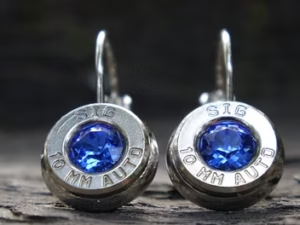
Discover the artistry of RedGlareUSA, a veteran-owned business crafting the most creative and unique items from spent bullet cases adorned with stunning Swarovski Crystals. Each piece is a testament to innovation, precision, and creative excellence—transforming ammunition into wearable art and collectible treasures all hand made in the USA! CLICK HERE to shop and support! https://redglareusa.com/
The Knife Was Reported, But Was It Ever Used to Threaten Officers?
The initial dispatch information included a report that Jackson possessed a large knife.
According to contemporary reporting, the knife was carried in a sheath, and the reporting witness did not describe Jackson waving it around.
Police ultimately recovered the knife after the shooting.
My concern is that the reported presence of a knife cannot substitute for examining what Jackson actually did during the encounter.
Based on the material discussed in my reaction, I did not identify Jackson drawing that knife or actively threatening the officers with it.
That distinction is important to my assessment, although the absence of a drawn knife does not eliminate every other potential threat.
I want officers trained to recognize the difference between a weapon being present and a weapon presenting an immediate deadly threat.
The Officer’s Verbal Threat Raises Another Serious Concern
One of the most disturbing moments addressed in my reaction is a statement I attribute to the male officer during the confrontation.
According to my video summary, the officer threatened to shoot Jackson in the head.
I believe that statement deserves careful examination.
An officer may issue forceful commands during a dangerous struggle, and threatening to use force is not automatically proof that an officer has decided to act unlawfully.
Nevertheless, I question the officer’s emotional control and decision-making when language like that occurs during an already chaotic encounter.
Was the officer communicating a legitimate warning? Was he frustrated? Had his decision-making begun to deteriorate?
I cannot establish his internal intentions from a statement alone.
But I absolutely believe investigators and trainers should evaluate the statement alongside the timing of the firearm presentation, the suspect’s movements, and the surrounding circumstances.
Professionalism matters most when officers are under pressure.
Could Better Defensive Tactics Have Saved Essex Jackson?
I believe they might have.
In my reaction, I specifically discuss the rear naked choke and other grappling-based control skills.
I believe there is a serious conversation to be had about the effectiveness of trained physical control techniques and the consequences of restricting officers’ tactical options.
However, I am not claiming that any neck restraint is risk-free or that applying one would certainly have prevented Jackson’s death. Neck restraints can themselves cause serious injury or death, and their legal and policy restrictions vary.
My broader criticism is of police training systems that may leave officers insufficiently prepared for prolonged, high-resistance physical encounters.
I would rather see officers develop genuine grappling proficiency, control skills, and confidence under physical resistance than depend almost entirely on a Taser and hope that it works.
Officers need options. They need practical training. And they need the judgment to use those skills appropriately.
CLICK HERE to get your copy of

The Criminal Review Is Complete — My Tactical Criticism Remains
There is an important development since the October 2024 incident.
The Maricopa County Attorney’s Office publicly lists the Essex Jackson shooting as “Cleared,” with a decision dated February 27, 2025.
That criminal-review outcome must be acknowledged.
My original reaction questioned the justification for deadly force and called for a criminal investigation. The county attorney’s recorded determination is not consistent with suggesting that criminal wrongdoing has since been established.
I also distinguish that prosecutorial decision from any separate departmental determination about tactics, training, or compliance with internal policy.
I have not independently verified a final Phoenix Police Department administrative finding for this incident.
And that brings me back to the central argument I make throughout this video.
An officer can avoid criminal prosecution and still make tactical decisions that deserve serious criticism.
Being cleared through criminal review does not automatically mean every decision leading up to a shooting represents the professional standard I expect from law enforcement.
My Final Assessment: This Should Never Be the Standard
After reviewing the sequence of events presented in this case, my position remains that the encounter reflects serious tactical failures.
I saw officers lose physical control of a suspect, lose control of their equipment, struggle to effectively restrain him, and ultimately resort to deadly force.
I believe better defensive tactics training, stronger physical control skills, and better decision-making could have created opportunities for a different outcome.
That is why I described this as a bad shooting.
I am not asking people to ignore the dangers these officers faced. I am asking them to examine whether those dangers were made worse by preventable mistakes.
And I am not going to accept the argument that because the job is dangerous, the public should refrain from scrutinizing how officers perform it.
Police officers carry tremendous authority, including the authority to use deadly force under legally justified circumstances.
With that authority comes an extraordinary responsibility to be physically capable, tactically proficient, emotionally controlled, and professionally accountable.
For me, the death of Essex Jackson is a reason to demand better training and higher performance standards.
I believe the profession can do better.
And I believe we should demand it.
Join Cop Talk LIVE Members Only
If you value independent police analysis, honest criticism, and professional discussions that go beyond the usual talking points, join me inside Cop Talk LIVE Members Only.
Membership starts at $10 per month and includes private briefings, professional discussions, case updates when available, and opportunities for direct participation.
Join Cop Talk LIVE Members Only on Patreon.
For additional police shooting breakdowns, officer accountability discussions, and professional law enforcement commentary, explore more Cop Talk LIVE videos and articles.
Do Not Meet the Standard — Become the Standard.
About The Author

Discover more from Cop Talk LIVE
Subscribe to get the latest posts sent to your email.


